
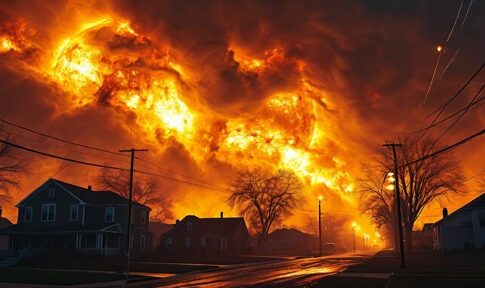
As Earth braces for a massive solar eruption today, power disruptions from Minnesota to Maine loom, threatening the very infrastructure that powers our daily lives.
Understanding the Solar Threat
Solar flares and coronal mass ejections (CMEs) have long been a concern for their potential to disrupt Earth’s power grids. The sun, currently in an active phase of its 11-year cycle, has recently unleashed an X1.9-class solar flare.
This flare, one of the most powerful on the solar scale, originated from sunspot region AR429 and peaked on November 30. The sunspot in question, AR4294, has grown in complexity and now poses a significant threat to Earth as it rotates into view.
The National Oceanic and Atmospheric Administration (NOAA) has been monitoring this solar activity closely. NOAA’s Space Weather Prediction Center has highlighted that the sprawling, magnetically complex nature of AR4294 makes it a prime candidate for generating Earth-directed CMEs, which can trigger geomagnetic storms that disrupt power grids. The current forecast anticipates a G2 geomagnetic storm by the evening of December 3, 2025, with possible continuation into subsequent days.
Potential Impact on Power Grids
The northeastern United States, particularly the power corridor from Minnesota to Maine, could experience voltage regulation challenges during the anticipated G2 storm. While modern infrastructure includes protective measures to mitigate these effects, the risk of localized or temporary disruptions remains. A G2 storm is moderate on the geomagnetic disturbance scale and, while not as severe as higher-level storms, can still cause power grid fluctuations, spacecraft anomalies, and degraded radio signals.
The geographic scope is significant, encompassing a vast area with major population centers that rely on stable electrical service. The combined history of AR4294’s activity and its current trajectory suggest that utility operators and emergency management officials are on high alert, ensuring systems are prepared to handle potential impacts.
Expert Insights and Future Concerns
NOAA forecasters express cautious optimism, noting that while no Earth-directed CMEs have been detected yet, the dynamic nature of AR4294 demands vigilance.
The potential for further X-class flares and Earth-directed CMEs is a looming concern, especially as AR4294 continues to face Earth. The situation underscores the importance of space-weather forecasting and the need for robust infrastructure-resilience strategies.
Looking beyond immediate threats, the ongoing solar activity from AR4294 highlights the longer-term implications for power infrastructure vulnerability.
As the sun continues its active phase, utility companies and emergency management agencies must prioritize preparedness and response plans. The public should remain informed and heed any advisories issued by NOAA and local authorities, who are likely to provide updates as the situation evolves.
They are the expected frequency flares for our bodies.