
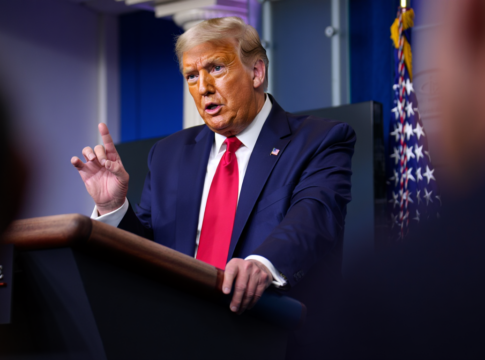
President Donald Trump indicated Monday that his administration may bypass Congressional approval to distribute $2,000 rebate checks to American families, citing substantial tariff revenue as the funding source. The proposal faces mounting skepticism from Republican lawmakers and potential legal challenges that could undermine the plan’s viability.
“I don’t think we would have to go to the Congress, but you know, we’ll find out,” Trump stated during his latest comments on the rebate program. “The reason we’re even talking about it is that we have so much money coming in from tariffs that we’ll be able to issue at least a $2,000 dividend and also pay down debt for the country.”
Constitutional Questions Over Presidential Spending Authority
The president’s suggestion that he could distribute the checks without legislative approval raises significant constitutional questions. Under the Constitution, Congress maintains exclusive control over federal spending through its power of the purse. Previous direct payments to Americans, including the COVID-19 relief checks distributed in 2020 and 2021, required explicit Congressional authorization.
Legal experts note that while the executive branch administers approved spending programs, initiating new expenditures typically requires legislative approval. Trump’s confidence in proceeding unilaterally suggests his administration believes existing statutory authority or emergency powers could justify the payments.
The timing of Trump’s latest comments coincides with growing political pressure to deliver on campaign promises ahead of the 2026 midterm elections, where Republicans face the challenge of maintaining Congressional control.
Republican Resistance Emerges in Congress
Despite Trump’s enthusiasm for the rebate program, several prominent Republican lawmakers have voiced concerns about the fiscal implications. These legislators argue that tariff revenues would be better allocated toward reducing the federal deficit rather than funding direct payments to citizens.
The internal party tension highlights a broader ideological divide within the Republican coalition between populist economic policies favored by Trump’s base and traditional fiscal conservative principles that prioritize debt reduction and limited government spending.
Some GOP members have privately expressed frustration that the rebate proposal could complicate their efforts to present a unified message on fiscal responsibility, particularly as the party prepares for challenging midterm races in competitive districts.
Supreme Court Challenge Threatens Funding Source
The entire rebate program faces an existential threat from pending Supreme Court litigation challenging the legality of Trump’s tariff policies. The administration imposed these tariffs using the International Emergency Economic Powers Act, but the high court is currently reviewing whether this application of emergency powers exceeds presidential authority.
Legal analysts expect the Supreme Court ruling to arrive within days or weeks, potentially eliminating the primary revenue source for the proposed rebate checks. The tariffs in question include what the administration terms “trafficking” and “reciprocal” tariffs designed to pressure other nations on trade practices.
If the Court strikes down these tariffs, the Trump administration would face the immediate challenge of identifying alternative funding sources for the $2,000 payments, likely requiring Congressional appropriations that currently appear unlikely given Republican skepticism.
Implementation Details Remain Unclear
Despite months of public discussion about the rebate program, Trump administration officials have provided limited specifics about how the payments would function in practice. Treasury Secretary Scott Bessent offered the most detailed guidance to date, suggesting income limitations could restrict eligibility.
“Well, there are a lot of options here; the president’s talking about a $2,000 rebate and those—that would be for families making less than, say, $100,000,” Bessent told Fox & Friends in recent comments, before quickly clarifying that income thresholds remain under discussion.
The lack of concrete details has frustrated both supporters and critics of the program, with some viewing the ambiguity as evidence that the administration has not fully developed the policy framework necessary for implementation.
Economic Impact and Cost Projections
Independent analysis from the Tax Foundation estimates that limiting $2,000 payments to individuals earning under $100,000 annually would cost approximately $300 billion. This figure represents a significant reduction from the estimated $464 billion cost of COVID-19 relief checks, according to calculations by the Committee for a Responsible Federal Budget.
The reduced cost projection reflects both the more restrictive income limits under consideration and changes in the eligible population since the pandemic-era payments. However, economists note that even the lower $300 billion estimate would require substantial and sustained tariff revenue to avoid increasing the federal deficit.
Critics argue that tariff revenues, which ultimately derive from taxes paid by American importers and consumers, represent an inefficient method of funding direct payments. They contend that the policy essentially redistributes money collected from consumers through higher prices on imported goods.
Political Timing and Electoral Considerations
The rebate checks’ failure to materialize before the 2025 holiday shopping season disappointed some Trump supporters who anticipated the payments would provide additional spending power during the crucial retail period. However, political strategists suggest the timing may ultimately benefit Republican candidates in the 2026 midterm elections.
Delivering the payments closer to the midterm elections could maximize their political impact, potentially boosting voter satisfaction with Republican governance at a critical moment. This calculation appears to influence the administration’s continued promotion of the program despite implementation challenges.
Democratic opponents have criticized the rebate proposal as a politically motivated gimmick designed to obscure the broader economic impacts of Trump’s trade policies. They argue that any temporary benefits from direct payments would be offset by the increased costs consumers face due to tariffs on imported goods.
As the Supreme Court deliberates and Congressional Republicans express growing reservations, the fate of Trump’s $2,000 rebate promise remains uncertain. The coming weeks will likely determine whether the president can deliver on this signature economic proposal or whether legal and political obstacles will force a significant revision of the plan.
We get it: false promises for another year
Overcoming serious health issues for Phyllis, Stephanie and James Kubiak.
I won’t hold my breath…
Yeah…. Right….
This is another piece that shows Congress is trying to be the collective President of the United States. We have a President who isn’t allowed to do anything unless Congress sticks their evil noses into it so why do we even have a President. Congress has said they are taking the President’s ability to do most anything away from him. What committee oversees Congress or even Senate? They are all the criminals of our government. And YES, we ARE getting the $2000.00. I don’t care if you don’t believe it. That is on you unbelievers who are against our President.
I WON’T HOLD MY BREATH !!!
ALL TALK AND NO ACTION !!!
How will citizens receive it? Through tax returns? Then what about seniors who no longer have to file?
The same way they get their monthly SS.
They could afford to give us a lot more if there wasn’t so much nationwide fraud. Too many political criminals making decisions and standing in the way of our President.