
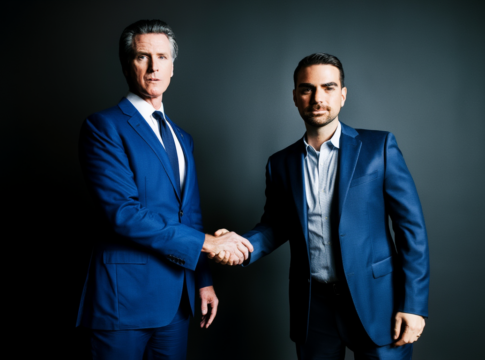
In an unexpected display of bipartisan dialogue, California Governor Gavin Newsom welcomed conservative commentator Ben Shapiro as a guest on his podcast this week, creating a rare moment of civil discourse between two prominent figures from opposite ends of the political spectrum.
The conversation, which aired Tuesday, marked a significant departure from the typical political theater that dominates American media landscapes. Newsom, widely considered a potential Democratic presidential candidate for 2028, and Shapiro, founder of The Daily Wire and influential conservative voice, engaged in substantive policy discussions that avoided the inflammatory rhetoric often associated with cross-party exchanges.
Breaking Through Political Echo Chambers
The podcast episode comes at a time when American political discourse has become increasingly polarized, with politicians and media figures rarely venturing outside their ideological comfort zones. Newsom’s decision to host Shapiro represents a calculated effort to demonstrate leadership beyond partisan boundaries, potentially signaling his approach to national politics.
During the hour-long discussion, the two addressed several contentious issues, including California’s housing crisis, federal fiscal policy, and immigration reform. While disagreements were evident, both participants maintained respectful tones and acknowledged areas where their perspectives aligned.
Some highlights from the conversation with Gavin Newsom. pic.twitter.com/pktleEScyX
— The Ben Shapiro Show (@BenShapiroShow) January 16, 2026
Political analysts suggest this type of engagement could serve as a template for more productive political discourse. The conversation avoided personal attacks and focused primarily on policy substance, a stark contrast to the combative style that has dominated political media in recent years.
Policy Positions Take Center Stage
Shapiro, known for his rapid-fire debate style and conservative commentary, appeared to moderate his typical approach for the podcast format. The discussion delved into California’s regulatory environment, with Shapiro presenting his critique of state policies while Newsom defended his administration’s record on economic growth and environmental protection.
One notable exchange centered on housing affordability, an issue that transcends party lines in California. Both acknowledged the severity of the crisis, though they proposed different solutions. Newsom emphasized the need for increased government investment in affordable housing, while Shapiro advocated for reduced regulatory barriers to private development.
The immigration discussion proved particularly illuminating, with both participants finding unexpected common ground on the need for comprehensive federal reform. Their disagreement centered on implementation methods rather than the fundamental recognition that the current system requires significant changes.
Gavin Newsom just COOKED Ben Shapiro on crime and population decline in red states. This is worth a watch: pic.twitter.com/2C1Udu661j
— Harry Sisson (@harryjsisson) January 16, 2026
Strategic Implications for 2028
Political observers are interpreting Newsom’s outreach to conservative voices as part of a broader strategy to position himself as a unifying figure ahead of the next presidential election cycle. By engaging with prominent conservatives like Shapiro, the California governor may be attempting to demonstrate his ability to work across party lines and appeal to moderate voters.
This approach contrasts with the more combative stance many Democratic politicians have adopted when dealing with conservative media figures. Newsom’s willingness to engage in substantive dialogue could differentiate him from other potential Democratic candidates who might be reluctant to appear on conservative platforms.
For Shapiro, the appearance on Newsom’s podcast provides an opportunity to reach audiences beyond his typical conservative base. The format allowed him to present his arguments in a more measured way than his usual rapid-fire commentary style, potentially broadening his appeal to centrist listeners.
Media Landscape Evolution
The Newsom-Shapiro conversation reflects broader changes in how political figures engage with media. Podcasts have become increasingly important platforms for long-form political discussions, offering alternatives to traditional television formats that often prioritize conflict over substance.
This shift toward podcast-based political communication allows for more nuanced discussions of complex policy issues. The format’s informal nature can encourage more honest exchanges between participants who might otherwise stick to scripted talking points in traditional media appearances.
I spoke with Gavin Newsom about how he is running the state.
As you can see in this video… there are some issues here. Interview drops 4PM PST. pic.twitter.com/nNVc3u5ywW
— Ben Shapiro (@benshapiro) January 15, 2026
Media experts note that successful political podcasts often feature unexpected guest combinations that generate both attention and substantive content. Newsom’s choice to host Shapiro follows this model while potentially establishing his show as a platform for serious cross-party dialogue.
Public Reception and Future Implications
Initial reactions to the podcast episode have been mixed, with some praising the civil tone and substantive discussion while others criticized both participants for legitimizing opposing viewpoints. This divided response highlights the challenges politicians face when attempting to bridge partisan divides in an increasingly polarized environment.
Democratic activists expressed concerns about Newsom providing a platform for conservative viewpoints, while some conservative commentators questioned Shapiro’s decision to engage respectfully with a liberal politician. These reactions underscore the political risks both participants took by engaging in good-faith dialogue across party lines.
Despite potential criticism from their respective bases, both Newsom and Shapiro appear committed to continuing such exchanges. The success of this episode could encourage other political figures to engage in similar cross-party conversations, potentially contributing to more productive national political discourse.
Looking Ahead
The Newsom-Shapiro podcast represents more than just an interesting media moment; it could signal a potential shift in how American political leaders engage with ideological opponents. As the 2028 election cycle approaches, voters increasingly express frustration with partisan gridlock and desire leaders who can work across party lines.
Whether this type of civil engagement translates into actual policy progress remains to be seen. However, the willingness of prominent figures from both parties to engage in respectful dialogue offers hope for more productive political discourse in the future.
The episode’s success may encourage other politicians to follow Newsom’s example, potentially creating new opportunities for substantive policy discussions that transcend traditional partisan boundaries. As American democracy faces ongoing challenges, such efforts to bridge political divides could prove increasingly valuable for the nation’s political health.