
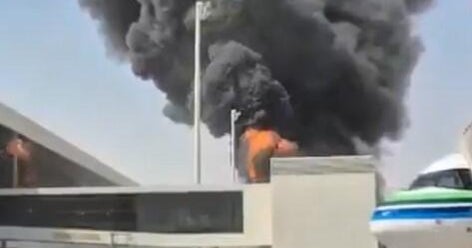
A missile strike on Saudi Arabia’s main international airport killed at least 12 people and injured over 300 on Saturday, marking the deadliest assault on any Gulf nation since the Iran war began. An American citizen was confirmed among the casualties as President Trump evaluates whether to authorize U.S. military action against the Iranian-backed Houthi rebels blamed for the attack.
Tehran-Backed Rebels Target International Airport
The missile slammed into a complex housing terminals 3 and 4 for domestic flights at King Khalid International Airport in Riyadh, Saudi Arabia’s capital. The dead included four Saudi citizens, two Bangladeshis, and one person each from Egypt, Jordan, Syria, Palestine, and Sudan, according to the General Authority of Civil Aviation. Several victims remain in critical condition across multiple hospitals as Saudi authorities extended the airport closure through Sunday.

Saudi civil aviation authorities earlier Saturday said airport operations were suspended.
Read the latest on The Times of Israel.
A Saudi-led coalition fighting in Yemen immediately blamed the Houthis, who earlier this week claimed responsibility for separate strikes on the same airport that killed three Saudis, including a pilot. The Houthis have not yet acknowledged Saturday’s deadlier attack. The Iran-backed rebels recently warned global airlines to avoid Saudi airspace, describing it as a theater for military operations.
Trump Administration Weighs Military Response
President Trump told reporters Saturday he was considering whether to join Saudi strikes against the Houthis. When asked about potential U.S. involvement, Trump responded directly: “We may. We’re gonna look at it. We just found out about the recent attack. So we’ll make a decision — we move very quickly.” Secretary of State Marco Rubio condemned the assault in a social media post, calling the Houthis terrorists and confirming the Trump administration maintains close contact with Saudi partners.
The State Department warned American citizens to avoid the airport, joining similar advisories from Britain, Germany, Australia, and Canada. The airport maintained a heavy police presence with all entrances blocked and lights dimmed as flights diverted elsewhere. United Nations special envoy to Yemen Hans Grundberg called the strike a dangerous escalation posing a grave threat to regional security.
What This Means For American Interests
The escalating attacks threaten the world’s top oil exporter and have rattled global energy markets. Saudi Arabia pushed forward with a major international energy conference in Riyadh despite the violence. Fighting between Houthis and Saudi-backed Yemeni government forces has intensified along the Red Sea, where recent Houthi territorial gains improved rebel surveillance of the Bab al-Mandab Strait, a crucial shipping corridor serving as an alternative to the Strait of Hormuz where Iran has attacked vessels. The Houthis previously targeted international shipping after the Gaza war began, claiming solidarity with Palestinians, until a U.S. bombing campaign sharply reduced those assaults.